Field Dispatch
Is Culture Africa’s Most Powerful Export?
Briefing Notes
For decades, Africa’s global story has been defined by commodities such as oil, gold, cocoa, and minerals.
But today another force is reshaping the narrative. Culture.
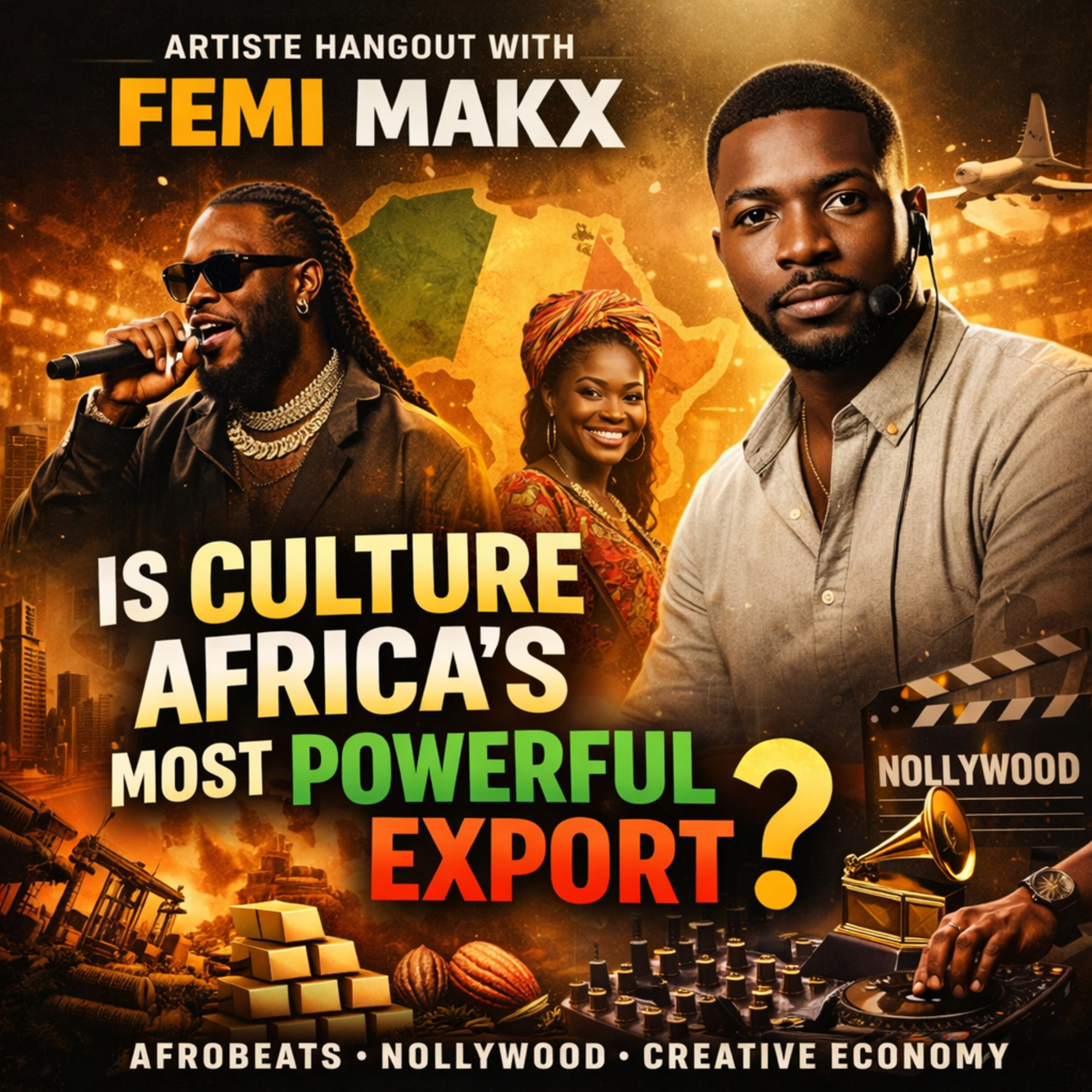
In this episode of Artiste Hangout with Femi Makx, we explore a question gaining global attention. Is culture now Africa’s most powerful export?
From the global rise of Afrobeats to the worldwide reach of Nollywood, African creativity is influencing music charts, film platforms, fashion, and digital culture. Artists like Burna Boy, Wizkid, Tems, and Rema are pulling billions of streams across the world, while African stories continue to expand their audience on platforms such as Netflix and Prime Video.
Beyond entertainment, the African creative economy is growing rapidly. Analysts project the sector could approach 200 billion dollars in value by 2030, creating millions of opportunities for young creatives across music, film, fashion, and media.
But can culture rival traditional exports?
Can creativity become one of Africa’s strongest economic forces?
In this episode, Oluwafemi Makanjuola, broadcast producer, reporter, and host of Artiste Hangout with Femi Makx, unpacks the numbers, the global influence, and the deeper shift happening in how Africa is seen and heard around the world. The episode explores both the opportunities and the structural challenges shaping the future of African creativity.
Artiste Hangout with Femi Makx continues to spotlight the voices, ideas, and industry conversations driving Africa’s entertainment and creative industries forward.
Welcome in. I want you to just pause whatever you're doing for a second and check your baseline assumptions. Always a good place to start. Right, because when you hear the phrase African exports, what is the very first image that comes to your mind? I mean if you are like most people, you are probably picturing heavy physical commodities. Exactly. You are envisioning oil rigs off the coast, or diamond mines, or maybe just massive shipping containers loaded with raw minerals heading across the ocean.
Yeah, we are so heavily conditioned to measure a continent's output in metric tons and barrels. But what if the most valuable export isn't in the ground at all? What if you need to look at your Spotify playlist, or your Netflix watch history, or even just the trending audio on your social media feeds to see the real economic engine at work? It requires A fundamental shift in perspective. Because of that traditional framework, we completely overlook the substantial intangible exports that are actively reshaping the global economy right now.
And that is the exact premise we are exploring today. Our source material for this deep dive is a set of excerpts from a piece called The Infinite Export Africa's Cultural Sovereignty. Specifically, we are focusing on a section that's provocatively titled Culture Africa's True Gold. Yeah, so the overarching mission of our deep dive today is to evaluate whether culture, meaning music, film, fashion and really the broader creative spectrum, is quietly but forcefully overtaking traditional physical resources as Africa's most potent export.
And we aren't just going to list what is trending on your screens. No, definitely not. OK, let's unpack this because reading through these sources, the way they frame this global shift really changes how you view the media you consume daily. It absolutely challenges the traditional economic metrics. The goal today is to look beneath the surface. We are going to examine why this shift matters on a macroeconomic scale, looking closely at the structural changes, the historical context and the long term implications for global trade and influence.
Right. But to truly appreciate the new wave, we really have to ground ourselves in the traditional economy first. You have to know what you're comparing it against. Exactly. The sources layout the tangible figures. Currently, Africa's merchandise exports sit in the hundreds of billions of dollars, and they are heavily, heavily dominated by commodities. We're talking about crude oil flowing from the Niger Delta and Angola. And we're looking at the vast cobalt reserves in the Democratic Republic of the Congo.
I mean, as an audience that follows global trade, you already know that our international tech supply chains run on this stuff. The battery and the device you might be listening to right now. Yeah, it runs almost entirely on that Congolese Cobalt. These are the heavy hitters of the traditional export market. And there is no denying the sheer financial weight of those traditional exports. I mean, they generate billions in international trade. They literally dictate geopolitical alliances. But the sources highlight a critical So what context regarding these physical resources they share.
A fatal flop. They are finite. Right, they are finite. Every barrel of oil pumped and every ounce of cobalt mine is 1 less in the ground. They deplete over time. And on top of that, their value is entirely tethered to the volatility of global markets. Yes, when commodity prices experience a downturn, entire national economies suffer the shockwaves. They are incredibly vulnerable. And the historical context there is equally troubling, right Africa has predominantly exported these resources in their rawest form.
That is the classic commodity trap. Other nations take those raw materials, they refine them, manufacture them into finished goods, and then capture the lion's share of the profit margin. The crucial value add happens completely outside the continent. Precisely, the continent has historically functioned as the extraction point while the wealth generation occurs in the refining and manufacturing hubs in Europe, Asia or North America. Which brings us to the pivot the text introduces. It contrasts this finite extraction base system with an entirely new wave of exports, and the examples cited are just so vibrant and immediate.
It's happening right in front of us. We are seeing Burnaboy selling out stadiums across Europe. We have artists like Thames collaborating with global mainstays like Drake Aristars. Music is penetrating international markets everywhere. And it isn't just music on the film side, Nollywood productions on Netflix are pulling in vast global audiences who have literally never set foot in Nigeria. African designers are claiming prominent space on the Runaways at Paris Fashion Week. And don't forget the Internet culture.
Oh man, yes, there are fierce global Internet meme wars over who makes the best Joloff rice. Which acts as this massive form of organic digital marketing for the region's culinary footprint. What's fascinating here is the core thesis. The source derives from all this cultural activity. It argues that culture is an infinite export. Yes, an infinite export. Consider the stark economic difference between an oil rig and a recording studio. OK, lay that out for us. When an oil well runs dry, the revenue stream stops completely.
The acid is depleted, but a recorded track, a film script or a unique fashion design operates on a completely different economic. Law. It multiplies. Exactly. The marginal cost of distributing an MP3 file or a streaming video across the globe is essentially 0. It scales endlessly without losing any of its original substance. But wait, let's push back on that for a second. I mean, we are talking about hundreds of billions of dollars in the oil and mineral trade. Can a sold out stadium tour or a hit song really compete on a macroeconomic scale with a tanker of crude oil?
In terms of immediate raw revenue today, no, the balance sheet still heavily favor physical commodities, so. Oil is still king on the spreadsheet. For now, but the source argues, we must look at the trajectory and the demographic impact this infinite export runs on human creativity rather than heavy industrial machinery. Which means it employs A vastly different demographic. Specifically youth, women and the global diaspora. It distributes wealth across a wider, more decentralized network of creators rather than concentrating it in the hands of state owned enterprises or multinational extraction firms.
That makes a lot of sense. It is a completely different velocity of money and it reaches different pockets entirely. If we connect this to the bigger picture, what we're really analyzing here are the mechanics of soft power. Right soft power. Historically, when looking at global influence rankings within the continent, nations like Egypt and South Africa have led the pack. But the data in the source material indicates that Nigeria is rapidly ascending that ladder. Driven almost entirely by the unstoppable momentum of Afrobeats and Nollywood.
Because soft power is the ability to shape the preferences of others through appeal and attraction rather than through coercion or financial payment. It's making people want to engage with you. Exactly when a nation exports its culture successfully, it shapes how the entire world perceives its people, its values and its potential. It is a diplomatic tool that operates outside of embassies and treaties. And the human element of that diplomatic shift is profound. The source text features a really relatable anecdote that highlights this.
The bit about the nice in Port Harcourt. Yes, the writer recalls how Western media historically painted Africa with broad, monolithic strokes, often focusing exclusively on poverty, conflict or crisis. Framed purely as a problem requiring outside intervention. Right. But now the writer notes that a nice living in Port Harcourt is vibing to the exact same playlists as teenagers sitting in London or Tokyo. The cultural baseline is shared. It really reminds me of how K Pop took over the global music scene a few years ago.
Suddenly, geography and language barriers simply didn't matter to the algorithm or the audience. The aesthetic and the production value breach the mainstream. And the source text implies Afrobeats is achieving a similar phenomenon, leveraging the diaspora to introduce the rhythm to Western charts until it just becomes ubiquitous. That K Pop comparison is spot on, and I want you, the listener, to reflect on your own perceptions of the continent for a moment. Think about how those perceptions have been actively reshaped over the last five or ten years.
It likely wasn't a policy paper that changed your mind. No, or a news broadcast. It was the storytellers, the musicians and the fashion designers you engage with daily. Every time you add an Afrobeat song to a playlist or stream a Nollywood thriller, your perception shifts. You are participating in that exchange of soft power. And it is a highly measurable exchange. While you cannot put a cultural aesthetic in a shipping container, you can track it through streaming numbers, concert ticket sales, and major corporate brand deals.
But this is where we need to apply strict critical analysis, right? Because the cultural footprint is expanding exponentially, but the underlying economic infrastructure supporting it is still playing catch up. Here's where it gets really interesting. Yeah, you read these success stories and it is easy to assume the creators have already won the game, but the source material is explicit that this transition is facing severe roadblocks. It is definitely not a frictionless rise to the top. The structural hurdles outlined in the text are formidable.
Where does it start funding? First and foremost, yes, the creative industries across the continent are drastically underfunded compared to Western markets. Even with all the venture capital flowing in? Well, while access to capital for a fintech startup in Lagos or Nairobi has improved significantly, securing funding for an Independent Record label or a high end film production remains a steep uphill battle. Because traditional banks don't get it. Traditional banks often do not know how to underwrite intellectual property.
They want physical collateral. Which leads right into the piracy issue. The text mentions it, but how exactly does piracy function in the modern streaming era? We aren't talking about bootleg DVD's sold out of the trunk of a car anymore, are we? No. The mechanics of modern piracy are highly digital and incredibly efficient. A Nollywood film budget, for example, can be cannibalized within hours of release. Hours just through leaks. High definition files are ripped and distributed through massive WhatsApp peer-to-peer networks or unauthorized streaming hubs.
Wow. These platforms siphon off the ad revenue and viewership before the legitimate studio can even begin to recoup its initial investment. And you combine that with infrastructure challenges, right? Like inconsistent broadband speeds necessary for rendering and uploading heavy digital files. Or a lack of global standard arenas required to host massive international music tours locally. The talent is constantly fighting the environment. That friction between the talent and the environment brings up what I found to be the most compelling argument in the entire text.
The brain drain. Yes, the concept of a brain drain in art. This raises an important question regarding the texts most critical, nuanced cultural influence has not yet translated into true economic sovereignty. The source uses several examples to illustrate this troubling pattern, where the continent is frequently exporting raw talent before it exports a finished vertically integrated product. Let's clarify vertical integration for the audience. Right. In this context, it means owning the record label, the touring company, the international distribution rights and the merchandising, rather than just getting paid a flat fee to sing in the recording booth.
Correct. When an artist signs a 360 deal with a major record label based in London or Los Angeles, that foreign label often owns the master recordings they own, a percentage of the touring revenue and the merchandise rights. So the artist gets a check but loses the asset. The artist receives an advance and global visibility, but the long term compounding wealth generated by that intellectual property leaves the continent entirely. We are basically treating cultural talent the same way we historically treated raw minerals.
Shipping it out to be processed, packaged and monetized by external entities. That is a grim comparison. Are you saying a talented designer in Legos or a musician in Johannesburg is economically no different than a raw piece of unrefined cobalt? Economically speaking, if they do not own the intellectual property in the distribution channels, their position in the global supply chain is distressingly similar. Because they don't own the final product. They provide the raw material, their talent and cultural aesthetic, but the bulk of the profit margin is captured by the foreign entity that controls the global distribution and marketing apparatus.
The Source brings up the fashion industry to make this exact point. We frequently see vibrant African prints and aesthetics showing up in collections by European luxury brand. It happens all the time. The aesthetic is celebrated. It walks down the runway in Milan OR Paris and the industry applauds the cultural appreciation. But the text asks a really pointed question here. How many African owned fashion houses actually own the narrative, manage the production and take home the high profit margins of those luxury sales?
Very few. The European luxury house takes the cultural aesthetic manufacturers. It slaps a premium label on it and captures 90% of the value. That is the crux of the issue. Having a cultural aesthetic utilized by a European fashion house is a form of influence, sure. But it is unequivocally not economic sovereignty right. Economic sovereignty requires controlling the means of production, the distribution networks and the intellectual property rights from inception to the final consumer. It is the difference between being the inspiration for the meal and owning the restaurant.
I love that phrasing. Until the creative industries can capture the full value chain of their infinite export, they remain vulnerable to a modern iteration of the old commodity trap. A modern iteration of the commodity trap that really crystallizes the danger. But despite these systemic hurdles, the source material maintains an incredibly forward-looking stance it. Is very optimistic about the future. When we examine the 2030 horizon, the text points to undeniable momentum. Institutional investors are waking up to the reality that culture scales faster than almost any physical asset.
We are witnessing A distinct shift in the institutional mindset. The trajectory toward 2030 shows a deliberate transition from accidental viral success to strategic industry building. What does that look like on the ground? We are beginning to see dedicated venture capital funds specifically targeting the African creative economy. Capital is actually moving from traditional sectors like agriculture and fintech into creative IP. And the governments are catching on, too. Policy makers are starting to realize that a robust intellectual property framework might be just as crucial to their national GDP as building physical roads and bridges.
The source projects that the creative economy could hit billions in verified exports by the end of decade, provided these investments in infrastructure and IP protection hold firm. So what does this all mean for the listener tracking these trends? If we step back and evaluate the entire picture painted by the sources, we have to weigh the outcomes. Is culture the most powerful export today in terms of sheer financial volume? No, Right? No. The data clearly shows that crude oil and extracted minerals still dwarf music and film on the raw balance sheets.
But if we measure power differently, if we measure it in terms of lasting geopolitical influence, opening doors on the global stage and shaping the demographic future of the next generation, then the creative sector is accelerating at an unprecedented rate. It represents A fundamental economic and psychological transition. The old commodity based system built vast wealth for a select few, but it rarely fostered widespread pride or a self determined global identity. This new infinite export accomplishes both.
It is about building wealth, pride and identity on their own terms. It allows a continent to define itself for the world through its own storytellers, rather than allowing the world to define it based solely on what can be physically extracted from its soil. That represents true enduring power. It is a power that redefines the global cultural hierarchy. As we wrap up this deep dive, I want you to carry this perspective forward. Every single time you stream an Afrobeats track, sit down to watch a Nollywood film, or engage with digital content born from these creative hubs, you are not just a passive consumer.
You are actively participating in the velocity of this infinite export. You are part of the ecosystem that is actively shifting the global balance of soft power. And as you participate in that ecosystem, I want to leave you with a final lingering thought to consider. Let's hear it. We spent significant time today discussing the historical trap of Africa exporting raw materials while other nations refine them and retain the profits. The source text suggests that culture is the new infinite raw material, but consider the mechanics of how you access that culture today.
Through our phones. You find it on global latforms like Spotify, Ale Music, Netflix, and Tiktok. If these four known tech platforms and their proprietary algorithms are the primary distributors, are they becoming the new refineries? Oh wow. Who really holds the true power and the ultimate economic sovereignty when the algorithms that dictate the global reach of this infinite export are controlled in Silicon Valley or elsewhere entirely outside the continent? That is a staggering thought to end on.
If the algorithms are indeed the new refineries, then the fight for true economic sovereignty is simply moving from the physical world of shipping lanes into the digital code of tech platforms. It forces you to rethink the entire global media landscape. It really does, and your place within it. Keep questioning the media you consume, look for the underlying economic structures behind the art, and continue exploring these cultural exports with a critical eye. It has been a fascinating discussion and we are glad you joined us to unpack the layers.
We will catch you on the next deep dive.
 Apple Podcasts
 Castbox
 Castro
 Goodpods
 Moon FM
 Overcast
 Pocket Casts
 Podbean
 Podcast Addict
 Podcast Republic
 Spotify